
UK online gambling guide · Prepared for UK readers: 23 May 2026
Casinos Not on GAMSTOP: UK Licence, Risk and Support Checks
 Available in GB
When a casino is described as “not on GAMSTOP”, the useful question is not whether that sounds convenient. The useful question is what protection, licence status, payment rules and support routes are actually in place before you trust the claim.
- No rankingsNo invented casino lists or bonus promises
- Official checks firstLicence, terms, complaint and support routes
- Protection awareSelf-exclusion and blocks are treated as safeguards

Essential Verification Before You Deposit
A casino described as outside GAMSTOP should be treated as a warning to slow down. For a Great Britain-facing online casino, the central check is whether the business is licensed by the Gambling Commission. Online gambling companies licensed in Great Britain must be part of GAMSTOP Online, so outside-GAMSTOP wording raises an immediate coverage and licence question.
This guide does not name casino brands, compare offers or send you toward alternatives. It explains what to check: licence status, visible licence details, age and identity verification, source-of-funds questions, credit-card rules, limits, account history, withdrawal terms, complaint routes, customer-funds wording, cookies, marketing and support options.
What “casino not on GAMSTOP” should make you check
For a UK reader, the phrase usually appears when an online casino is being presented as separate from GAMSTOP Online. That may sound like a simple product label, but it is a loaded phrase. GAMSTOP is tied to online self-exclusion from companies licensed in Great Britain. If a site is being promoted as outside that system, the first question is not whether it has a large welcome offer, fast access or relaxed account rules. The first question is whether it is licensed for the market it is trying to serve and whether the protective controls that a UK reader may rely on are present.
The Gambling Commission’s remote-gambling guidance is the important boundary for Great Britain. A business that provides remote gambling facilities to consumers in Great Britain needs the correct Gambling Commission licence, even if the business is based abroad. That means “offshore” wording does not remove the need for a Great Britain licence check when the business is targeting or serving Great Britain consumers.
GAMSTOP also changes the way the phrase should be understood. Online gambling companies licensed in Great Britain must be part of GAMSTOP Online. So a claim that a casino is not on GAMSTOP is not automatically a harmless feature. It may mean the business is not licensed for Great Britain, or that the claim is being used loosely in advertising. Either way, it is a reason to verify, not a reason to rush.
Key takeaway
Outside-GAMSTOP wording should be handled as a licence, protection and risk-check issue. It should not be treated as proof that a casino is suitable, safe, easy to withdraw from or appropriate for someone who has self-excluded.
It is also important to separate curiosity from urgency. Some readers are simply trying to understand a phrase they have seen. Others may be actively looking for gambling after self-excluding, hitting a bank gambling block, reaching an account limit or being asked for verification. Those are different situations. The practical checks below are useful for everyone, but if the reason for looking is pressure, chasing losses or trying to get around a protection, the safer next step is support and stronger protective layers.
How to read licence claims without relying on badges
A serious licence check should start with the Gambling Commission public register, not with a logo at the bottom of a casino page. The register can be used to search licensed businesses and regulatory actions, and the business-register search supports checks by business name, trading name, domain name and account number. That matters because a gambling site may use a trading name that differs from the legal business name, and a marketing page may display a badge without giving you enough context.
For remote gambling, licensed businesses must display a licensed-and-regulated statement, an account number and a Gambling Commission status link on screens from which customers access gambling facilities. Treat those details as a starting point, not as the entire check. A responsible user should compare the displayed details with the official register and check whether the domain, trading name and account number fit the same business.
Check the business identity
Look for the legal business name, trading name and account number. If the site only shows a vague badge or a foreign licence label, that is not enough for a Great Britain licence check.
Check the domain trail
Use the official register to see whether the domain is connected to the business record. A similar name or a copied badge is not the same as verified status.
Check regulatory status
The register is also the route for public statements and regulatory actions. Read the record carefully before trusting any claim aimed at UK players.
Do not treat a foreign licence as a substitute for a Gambling Commission licence where the business is serving Great Britain consumers. A foreign licence may be real in its own jurisdiction, but that does not answer whether the site is authorised for Great Britain or whether GAMSTOP coverage, complaint routes, credit-card rules and customer protections apply in the way a UK reader might expect.
Useful official checks
- Gambling Commission public register for licensed businesses, regulatory actions and public statements.
- Gambling Commission business register for business-name, trading-name, domain and account-number checks.
- Gambling Commission consumer safety guidance for practical online checks.
There is no need to become a licensing specialist to do the first layer of checking. The sensible approach is modest: if the business cannot be matched clearly to a Great Britain licence, if the displayed account number does not make sense, if the domain trail is unclear, or if the site leans on vague “international” wording while speaking to UK players, do not treat it as verified.
GAMSTOP, bank blocks and protective tools are not obstacles to defeat
GAMSTOP Online is a free self-exclusion tool for people living in the UK. It covers online gambling companies licensed in Great Britain, and the exclusion cannot be removed during the minimum period. That point is central to this topic. If you are self-excluded, looking for a casino outside GAMSTOP is not a neutral shopping decision. It may be a sign that a protection you set up is doing its job at a difficult moment.
Protection tools work best in layers. GAMSTOP can sit alongside bank gambling blocks, blocking software and talking support. GamCare describes bank gambling blocks as free tools offered by most UK banks and recommends layering them with self-exclusion and blocking software. TalkBanStop is built around that layered approach: support through GamCare, self-exclusion through GAMSTOP, blocking software through Gamban and bank blocks or tools.

If you are trying to gamble despite a block
Pause before opening a new account. Trying to gamble through self-exclusion, a bank block, a spending limit or a verification hurdle can be a sign that the next useful step is support. You can use official support pages such as GamCare support, TalkBanStop, GAMSTOP registration and the NHS gambling help information page to find current help routes.
Bank gambling blocks are not a promise that every possible transaction will be stopped, and blocking software is not a guarantee that every route will disappear. They are useful safeguards because they add friction at the right moment. If one layer does not feel strong enough, adding another protective layer is more useful than searching for a weaker gambling environment.
The language around this topic matters. A page that frames outside-GAMSTOP access as freedom from checks, limits or self-exclusion is ignoring the reason those tools exist. A safer way to think about it is this: if a tool was set up to stop or slow gambling, the tool should be respected. The fact that you are looking for a way around a barrier can be the clearest signal that the barrier is important.
Payments, ID checks and limits before any deposit
Payment and verification claims are often where risky casino advertising becomes most tempting. A reader may see promises of fast sign-up, easy deposits or minimal checks. In regulated online gambling, however, age and identity verification are not unusual barriers; they are part of the control framework. Online gambling businesses must verify age and identity before gambling, and they may ask for financial or source-of-funds information for anti-money-laundering or customer-interaction reasons.
That means loose-check advertising should be read carefully. If a site is praised because it appears to avoid identity checks, source-of-funds questions or account controls, ask why that would be good for the customer. Verification can be frustrating, especially when documents are requested at a difficult time, but a blanket promise of friction-free gambling is not the same as a safer experience.

Payment and account-control checks
| Area | What a careful reader checks | Why it matters |
|---|---|---|
| Age and identity | When ID is checked, what documents may be requested and whether the business explains the process clearly. | Regulated businesses must verify age and identity before gambling. |
| Financial questions | Whether the terms explain source-of-funds or affordability-related questions in plain language. | A business may request financial information for anti-money-laundering or customer-protection reasons. |
| Credit-card boundary | Whether the payment information respects the Great Britain rule against credit-card payments for online betting, casino and bingo. | Promising routes around payment restrictions is a warning sign. |
| Limits and history | Whether deposit, spend and loss limits are available and whether account history can be accessed. | Limits and history help a customer see what is happening before gambling becomes harder to control. |
Credit cards deserve special care. Great Britain gambling businesses must not accept credit-card payments for online betting, casino and bingo, and they should ensure that e-wallet funds were not loaded by credit card. A public guide should never explain payment workarounds. The safer guidance is simple: if a payment claim sounds designed to step around a protection, do not treat it as a customer benefit.
Limits and account history also deserve attention before you deposit. Remote gambling standards cover financial limits such as deposit, spend and loss limits, and they also cover access to account and gambling history. These tools are not just small account features. They help people see their actual behaviour, set boundaries and notice changes before a session becomes a loss-chasing cycle.
Withdrawal terms, bonuses, complaints and customer funds
Bonus wording can distract from the terms that matter most. A careful reader should look past the headline and read how the business handles deposits, bonus balances, wagering conditions, withdrawal restrictions, dormancy, account closure and identity deadlines. Gambling businesses are expected to treat customers fairly, openly and transparently, and CMA material on online gambling has addressed promotions, practices and account withdrawals.
Customer Funds Risk Calculator
Gambling businesses must state whether your money is protected if they fail. The Gambling Commission describes three levels – no, medium and high protection. Enter your account balance and the operator’s stated level to see how much could be at risk.
How to read this: the levels reflect the Gambling Commission’s customer-funds framework. High means funds are held in a trust or equivalent that is intended to be returned to players ahead of other creditors; medium means some separation but weaker legal standing; no means your balance is treated like any other company debt if the business fails. The risk shown is an illustration of exposure, not a prediction that any operator will fail – and it never guarantees a full return even at “high”. The practical takeaway: withdraw rather than leave a balance sitting on account, and read the funds statement before you deposit. 18+ – support: GamCare 0808 8020 133.
One important practical point is the separation of deposit and bonus balances. Players must be able to withdraw deposit balance when a bonus is pending or active, subject to general regulatory obligations, and deposit and bonus balances should be clear and separate. That does not mean every withdrawal will be instant or every dispute will favour the customer. It means unclear terms, pressure tactics or conditions that make it hard to understand your own balance are reasons to stop and ask questions before depositing.
Do read
- Withdrawal rules before accepting any promotion.
- How deposit balance and bonus balance are shown separately.
- Identity, document and source-of-funds timing.
- Dormancy, closure and account-restriction wording.
- Complaint stages and the named dispute-resolution route.
Do not rely on
- Big headline numbers without clear conditions.
- Urgent claims that push you to deposit before reading terms.
- Promises that every withdrawal will be simple.
- Unverified social posts about easy payouts.
- Pages that ignore licence and complaint checks.
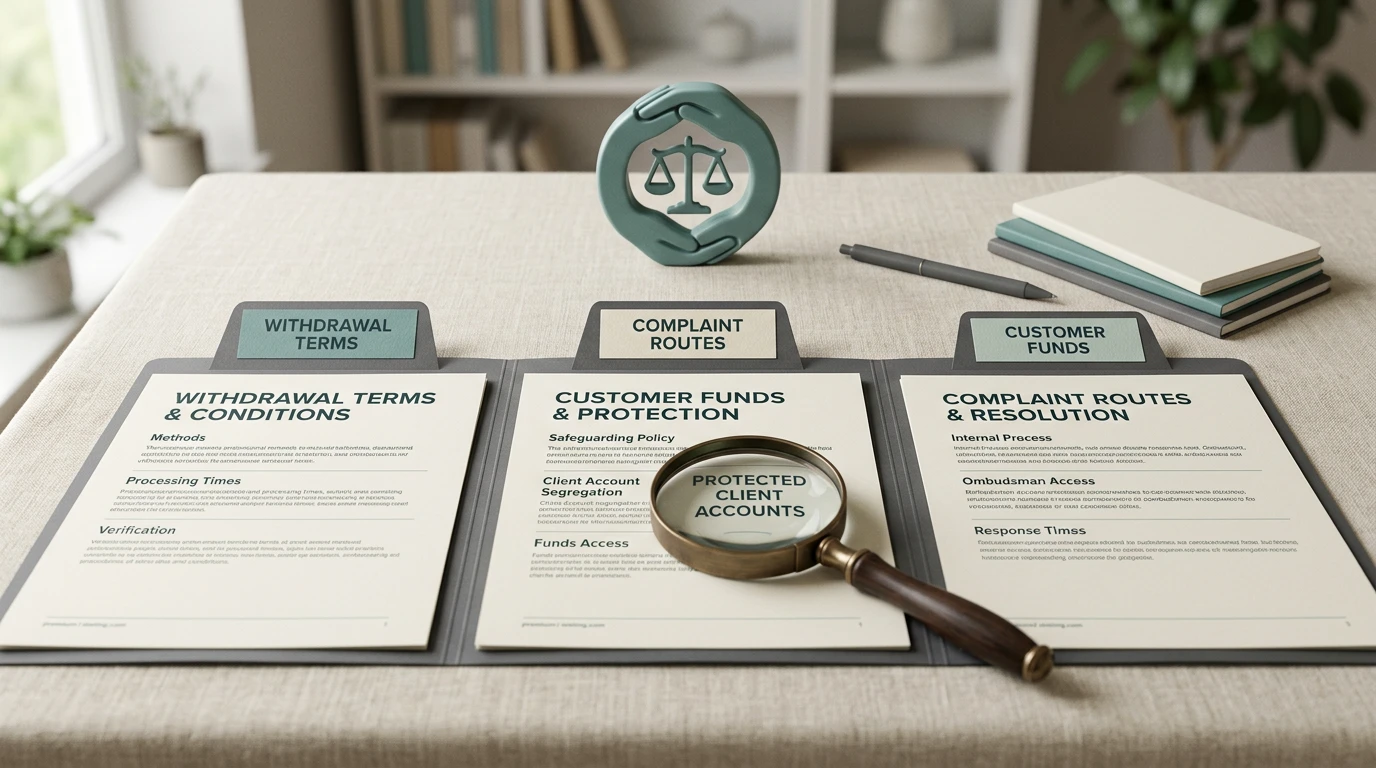
If a complaint happens, do not start from a refund promise. Start from the process. Unresolved complaints can move to a free alternative dispute resolution provider after the business complaint process and the required time period. The Gambling Commission is not an ombudsman for individual complaints and cannot resolve an individual case or get money back for a customer. That boundary matters because it prevents false expectations.
Customer-funds wording is another quiet but important check. Gambling businesses must tell customers whether funds are protected if the business goes bust, and the Gambling Commission describes levels of protection as no, medium and high. This is not a guarantee that a customer will never lose money through gambling. It is a business-failure risk check that should be read before depositing, especially if a site asks you to hold a balance on account.
Scenario: the offer looks attractive, but the terms are unclear
A careful next step is not to compare the size of the offer. It is to read whether you can withdraw your deposit balance, how bonus and deposit balances are separated, when ID might be requested, what happens to inactive accounts and how complaints are handled. If the answer is hard to find, that lack of clarity is information in itself.
Data, cookies and marketing checks are part of the risk picture
Creating a gambling account is not only a money decision. It is also a personal-data decision. Registration can involve identity details, address information, payment information, gambling history, contact preferences and sometimes financial documents. A reader should know how the business explains data use before registering, not only after marketing messages start or a document request arrives.
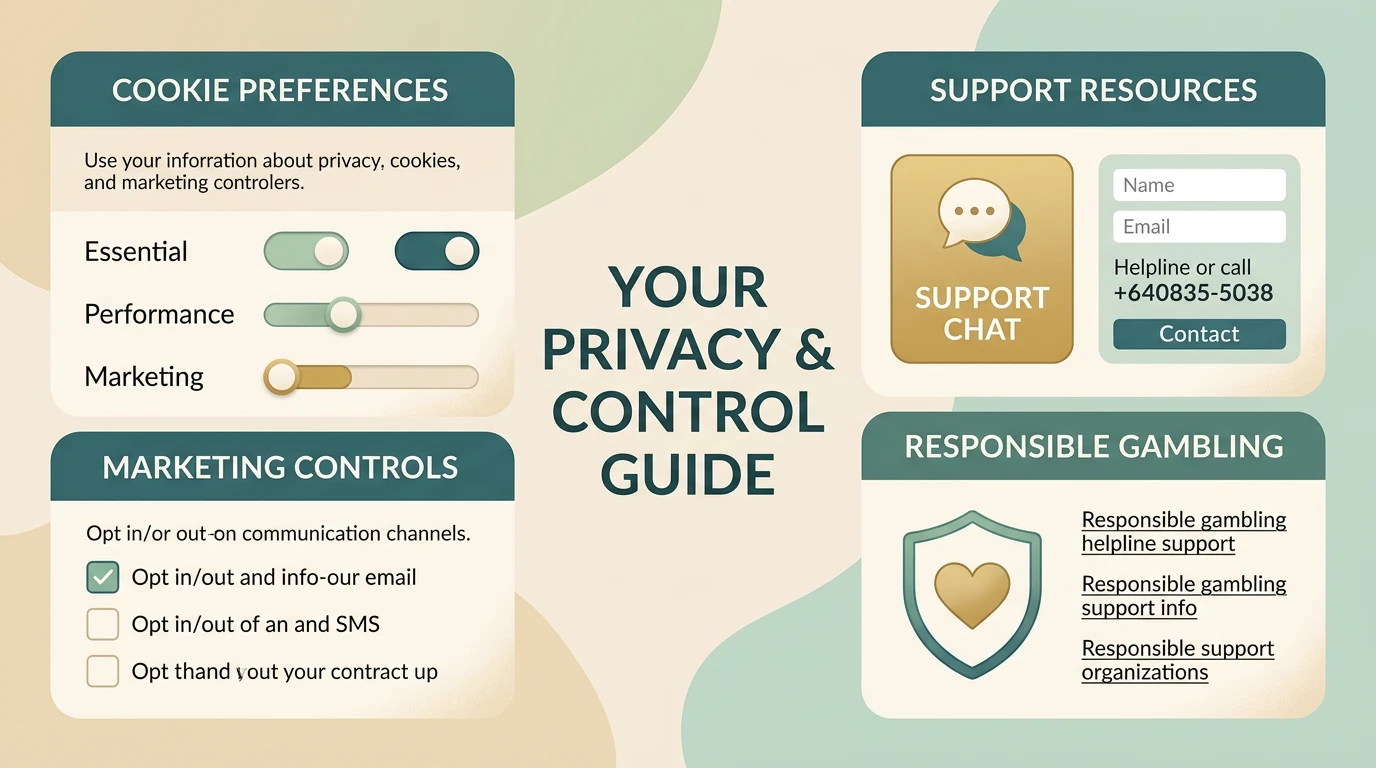
ICO guidance covers individual data rights and the right to object to direct marketing. Cookie guidance also says consent for non-essential cookies must be freely given, specific and informed. In plain language, a gambling site should not make it hard to understand what cookies do, how marketing preferences work or how a customer can object to direct marketing. The ICO has taken enforcement action in a gambling-cookie case involving advertising-cookie processing without consent, which shows why cookie and marketing checks are not a side issue.
Practical privacy signals
- Clear privacy notice: the site explains what data it collects, why it uses it and how long it may keep it.
- Cookie choice: non-essential cookies are explained in understandable language and consent is not buried behind confusing screens.
- Marketing control: email, text and other direct marketing choices are easy to find and change.
- Document handling: the business explains how verification documents are requested and handled.
- Support connection: the site does not use marketing pressure against someone showing signs of harm.
A privacy check will not tell you whether a casino is good. It will tell you whether the business explains sensitive matters clearly enough for you to make an informed account decision. If a gambling site makes it hard to understand cookies, marketing, document requests or data rights, that should sit beside the licence, payment, withdrawal and complaint checks.
A decision path for outside-GAMSTOP claims
The safest way to handle an outside-GAMSTOP claim is to slow the decision down. A claim can be checked in stages. Each stage asks a different question, and a weak answer at any stage is enough reason to stop. This is especially important if the claim is paired with pressure, urgency, loose-check promises or a promise that protections will not apply.
-
Check the Great Britain licence position
Can you match the business, trading name, domain and account number to the Gambling Commission register? If not, do not treat the casino claim as verified for UK readers.
-
Check why GAMSTOP is mentioned
If the site is licensed in Great Britain, it should be part of GAMSTOP Online. If it is presented as outside GAMSTOP, ask whether the claim is signalling a missing protection or a missing licence trail.
-
Check your own reason for looking
If you are self-excluded, blocked by a bank tool, near a limit or chasing losses, move toward support and protective tools instead of another gambling account.
-
Check payment and verification wording
Do the terms treat age, identity, financial checks, credit-card rules and account limits clearly? If a site markets loose checks as a benefit, treat that as a warning sign.
-
Check withdrawals, complaints and funds
Can you understand how withdrawals work, whether deposit and bonus balances are separated, who handles complaints and how customer funds are protected if the business fails?
-
Check data and marketing
Can you understand cookies, privacy, document handling and marketing choices before registering? If not, do not hand over sensitive information just to find out later.
This path is deliberately conservative. It does not require you to prove that every bad outcome will happen. It asks whether the basic trust signals are clear enough before you expose money, identity documents and personal data. If a claim fails the basic checks, you do not need a more dramatic reason to walk away.
What not to trust on its own
Some claims sound reassuring because they are short and confident. That is exactly why they need caution. A short slogan can hide the parts of the decision that a customer actually needs to understand: licence status, account controls, withdrawal conditions, complaint handling, data use and support options. Use the following list as a quick screen before reading any gambling claim further.
Slow-down checklist
- Do not trust a casino badge unless the official register record can be matched to the business and domain.
- Do not treat relaxed identity checks as a customer benefit.
- Do not treat payment workarounds as safer or more convenient.
- Do not treat a foreign licence label as an answer to the Great Britain licence question.
- Do not accept a bonus before you understand deposit balance, bonus balance and withdrawal restrictions.
- Do not ignore a bank block, self-exclusion or limit because another site appears to accept you.
- Do not rely on refund promises from pages that are not part of the official complaint route.
- Do not share documents with a site that does not clearly explain privacy, cookies and data handling.
Support, safer next steps and official resources
Support is not only for a crisis. It can be useful when gambling starts to feel urgent, secretive, hard to pause or tied to debt, loss chasing or stress. If outside-GAMSTOP searches are happening because a protection is in the way, that is a serious moment. You do not need to wait until the situation is extreme before using support pages or adding protective layers.
Licence and consumer checks
Use the Gambling Commission public register and consumer guidance to check licence status, online safety, verification, complaints and money-related information.
Self-exclusion and protection
Use GAMSTOP Online for UK online self-exclusion from Great Britain-licensed companies. TalkBanStop can help layer talking support, self-exclusion, blocking software and banking tools.
Gambling harm and money worries
GamCare, NHS gambling help information and MoneyHelper gambling-and-debt guidance can help when gambling is affecting wellbeing, bills, debt or day-to-day decisions.
If you need urgent mental-health help, use current NHS urgent-help guidance or emergency services where someone’s life is at risk or they cannot be kept safe. This guide is not a medical, legal or debt-advice service; it is a practical checkpoint so that a risky gambling phrase is not mistaken for a safe route.
Read the deeper checks
This hub gives the broad route. The deeper guides each answer a different practical question so you can follow the part that matches your situation without mixing licence checks, account rules, disputes and support into one confusing decision.
What to clarify about licence status, GAMSTOP and support
Does a casino outside GAMSTOP mean it is safe for UK players?
No. It should make a reader check the Gambling Commission register, displayed licence details, terms, payment rules, complaints route and support needs before taking any action. The phrase does not prove that a business is suitable for UK readers.
Is a foreign licence the same as a Gambling Commission licence?
No. For a Great Britain-facing remote gambling business, the important check is whether the business is licensed by the Gambling Commission for Great Britain. A foreign licence label does not answer that question on its own.
Can identity checks be avoided at a regulated online casino?
Age and identity checks are part of regulated online gambling. A business may also ask financial or source-of-funds questions for anti-money-laundering or customer-protection reasons. Advertising that treats loose checks as a benefit should be handled carefully.
What should a self-excluded reader do if they feel drawn to
gambling again?
The safer route is support and protective layers such as GAMSTOP, bank gambling blocks, blocking software and talking support, rather than looking for another place to gamble. If the urge feels hard to stop, use current official help routes.
Who handles a gambling complaint?
A customer normally starts with the gambling business complaint process. If it remains unresolved after the required process and time period, it can move to an approved alternative dispute resolution provider. The Gambling Commission does not act as an ombudsman for individual refunds.