
Casino Payments & ID Checks: Fast Withdrawal Rules
 Available in GB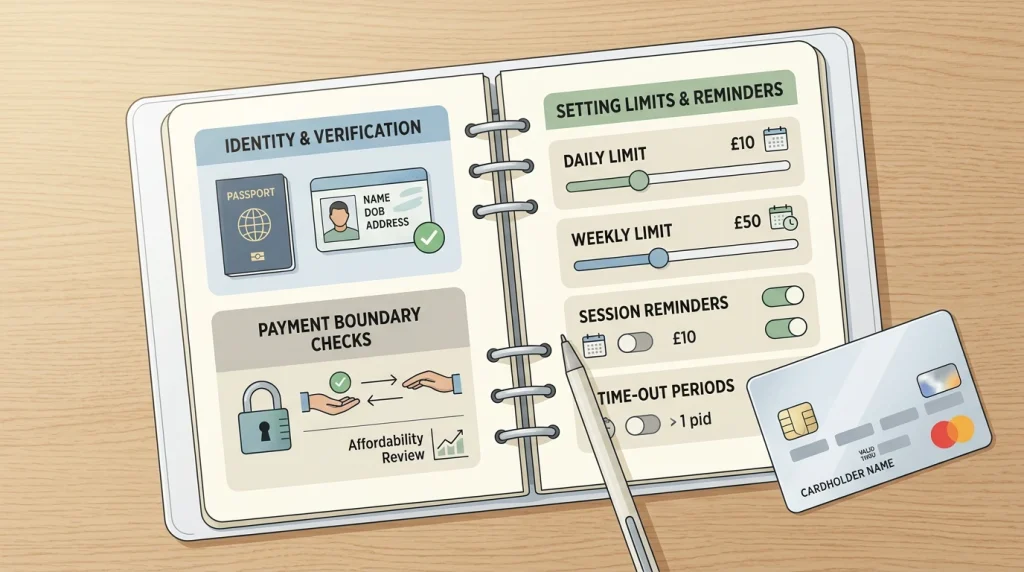
Payment pages can look simple, but they often sit on top of important rules. Before depositing with any online gambling site, especially one promoted as outside GAMSTOP, read the payment and account-control information as a protection check. The question is not “how can I avoid checks?” The useful question is “what will the operator ask for, what limits can I set, and what happens if the information is not clear before I put money in?”
In regulated online gambling, identity checks and financial questions are not unusual obstacles. They are part of the system that checks age, identity, self-exclusion status and financial risk. A site that presents loose checks as a benefit may be asking you to value convenience over protection. That is risky, particularly if you have already used self-exclusion, bank blocks or spending limits.
Once your identity is verified, carefully read the withdrawal rules and bonus conditions before claiming any promotional offers.
Identity Verification and Age Checks
Online gambling businesses must verify age and identity before gambling. That simple rule changes how you should read any promise of instant access with weak or unclear identity checks. The safer reading is that you should expect clear, early checks rather than a surprise request after you have already deposited or tried to withdraw. If a site makes verification sound optional, hidden or easy to avoid, slow down and check whether the wider licensing picture is clear.
Identity checks can also connect to self-exclusion checks. If you are interested in outside-GAMSTOP gambling because a self-exclusion has blocked access elsewhere, the check is doing protective work. It is not just paperwork. Trying to find a site that will not recognise the problem can make harm worse. A payment page should never be treated as a route around a protective decision you have already made.
Financial and source-of-funds questions
Operators may ask for financial information, bank statements or source-of-funds evidence in connection with anti-money-laundering duties or customer-interaction responsibilities. That does not mean every customer will be asked the same thing or at the same moment. It does mean you should read the terms and help pages before depositing, so you know what kinds of questions might be asked and how the operator explains them.
Do not assume that a lighter-looking signup process means fewer responsibilities. If a site gives no clear explanation of identity, financial checks or document handling, that is not a useful advantage. It is a gap. You may be handing over money and personal data without knowing how the account will be reviewed, what information may be requested, or how a withdrawal could be affected by unresolved checks.
Credit-card boundaries
Gambling Commission guidance says GB gambling operators must not accept credit-card payments for online betting, casino and bingo. Operators should also consider whether e-wallet funds were loaded using a credit card. This is not a boundary to test. The point of the boundary is to reduce gambling with borrowed money and to keep payment checks meaningful.
For that reason, avoid any page that pushes credit-card use, wallet funding tricks or workarounds. A trustworthy payment page should make the rules understandable, not encourage you to route around them. If you cannot tell what payment rule applies, treat that as a reason to stop reading the deposit screen and return to official licence and terms checks.
Before-deposit decision path
- Licence visible? Check the licensed status, account number and official register entry before treating a payment page as reliable.
- Identity check understood? Read when age and identity checks happen and what the operator says about further information requests.
- Payment boundary clear? Check that payment information is plain and does not encourage credit-card or wallet workarounds.
- Limits available? Look for deposit, spend and loss limits before you deposit, not after an emotional session.
- Account history accessible? Licensed remote standards cover access to account and gambling history, including at least three months easily and at least 12 months on request.
- Support tools considered? If you feel pulled toward gambling while a block is active, use support and protective tools instead of searching for a payment route.
Payment and account-control checklist
| Area | What to read before depositing | Why it matters | Unsafe reading |
|---|---|---|---|
| Age and identity | When proof is required and how the site explains the checks. | Verification should happen before gambling and should not be a hidden surprise. | “No checks” as a selling point. |
| Financial information | Whether the site explains source-of-funds or affordability-related requests. | You may need to provide information connected with risk or legal duties. | Assuming a quick signup means no later questions. |
| Credit cards | Whether the payment page respects the credit-card boundary for GB online gambling. | Borrowed-money gambling controls are protective, not decorative. | Following a workaround suggested by an advert or chat message. |
| Deposit, spend and loss limits | Whether you can set meaningful limits before play starts. | Limits are easier to set calmly than during a losing or chasing session. | Treating limits as something to remove or avoid. |
| Account history | How to see account and gambling history. | History helps you review patterns and check what has happened to your balance. | Using a site that makes account records hard to understand. |
How limits should be used
Deposit, spend and loss limits are not signs that a site is unfriendly. They are controls. In practice, the safest time to choose a limit is before you feel pressure, excitement or frustration. The limit should reflect what you can afford to lose without affecting bills, debt, family money or essential plans. If the only limit that feels acceptable is a very high one, that is a signal to pause rather than a reason to keep increasing it.
Account history also matters. It lets you see deposits, withdrawals and gambling activity over time. A clear account history can help you notice chasing, repeated deposits or sessions that feel different from what you intended. If you cannot easily review your account activity, you have less information to make safe decisions.
When the right answer is not another payment method
If you are looking for a way to deposit because another site, bank, limit or self-exclusion has stopped you, the payment page is no longer just a payment page. It is a point where you can either strengthen protection or weaken it. Gambling blocks and verification checks are not failures to be overcome. They can be useful barriers between an urge and a harmful decision.
When gambling feels hard to control, step away from the deposit screen. Consider support, self-exclusion, bank blocks, blocking software and talking to someone who can help you put practical distance between you and gambling. The page on self-exclusion, bank blocks and support is the better next step in that situation.
Payment and ID checks people often misunderstand
Is a no-verification promise a good sign?
No. For UK-facing regulated online gambling, age and identity checks are expected. A promise that makes checks sound avoidable should be treated as a warning sign, not as a convenience feature.Can a gambling site ask where money came from?
It may request financial or source-of-funds information in connection with anti-money-laundering or customer-interaction duties. Do not assume exact document types or review times unless the operator has clearly explained them and you have checked the current terms.Should I deposit first and check terms later?
No. Read licence details, payment rules, identity checks, limits and withdrawal terms before committing money. Once money is in an account, pressure and urgency can make calm reading harder.
Discover reliable operators with fast payouts on our main guide to trusted non Gamstop casinos.
Checks to continue after reviewing payments
- Check the online casino licence first
- Read withdrawal rules and bonus terms
- Use support if limits or blocks are part of the situation
- Return to the main guide